Most HVAC companies get their leads from one of two places: word-of-mouth from happy customers, or expensive Google Ads that they can never quite make work consistently. Both have real limitations — referrals are unpredictable, and paid ads stop the moment your budget does.
The HVAC companies that grow most reliably build a multi-channel lead system where several strategies work together. A homeowner might find you on Google Maps, check your reviews on Yelp, see your truck in the neighborhood, and then book because a neighbor mentioned you. Each channel reinforces the others.
Here are the 9 lead generation strategies that consistently work for HVAC contractors in 2025.

Strategy 1: Google Local Services Ads (LSA)
If you're spending money on paid advertising, Google LSA should be your first dollar. Unlike regular Google Ads where you pay per click (and plenty of clicks don't convert), LSA charges you only when a verified customer calls or messages you directly through the ad.
Why LSA Works So Well for HVAC
LSA ads appear above everything else in search results — above regular Google Ads, above the 3-Pack, above organic listings. They display the Google Guaranteed badge, which significantly boosts trust for emergency service searches. When someone types "AC repair near me" at 10pm on a hot July night, the LSA result at the very top with a phone number gets clicked first.
How to Maximize LSA Performance
- Get Google Guaranteed: Complete the background check and license verification. The badge appears on your ad and dramatically increases call volume.
- Set tight service areas: Don't try to cover your entire metro. Target your core service zip codes for the best lead quality and cost efficiency.
- Dispute bad leads: LSA lets you dispute leads that weren't genuine service calls. Use this — it directly reduces your cost per job.
- Respond immediately: LSA's algorithm rewards fast response times with better placement. Answer every call within seconds during business hours.
Strategy 2: Organic SEO + Google Business Profile
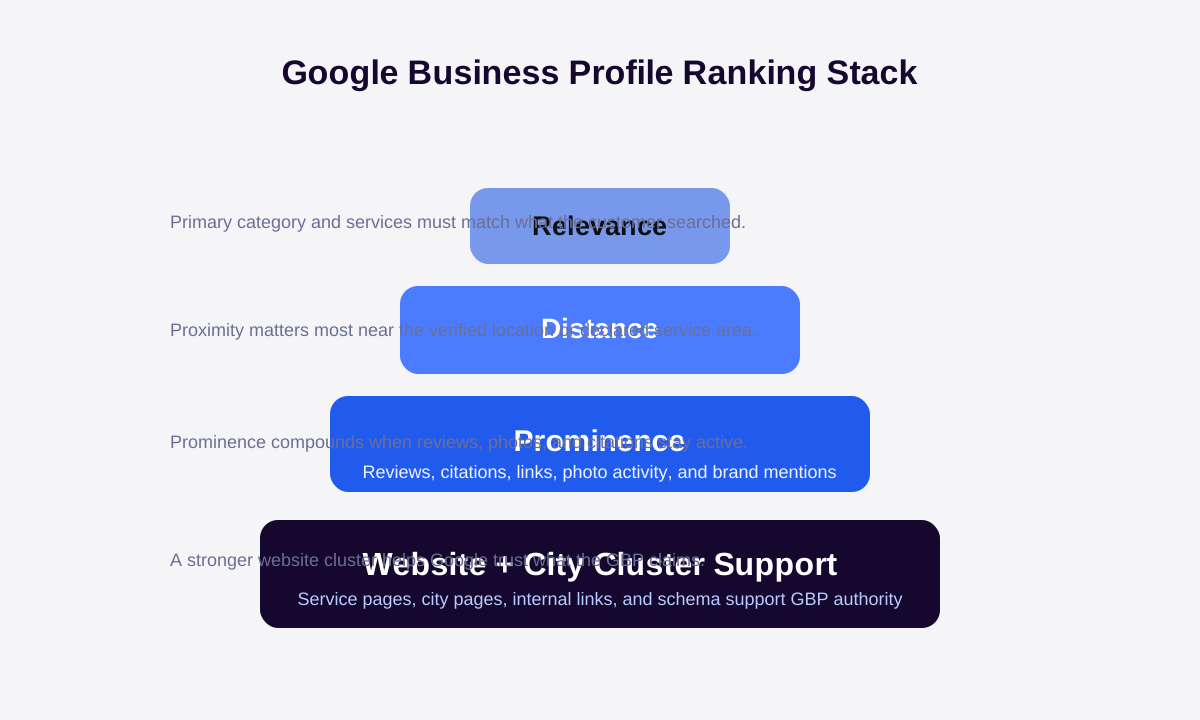
LSA gets you to the top fast, but organic SEO makes you unbeatable long-term. A well-ranked HVAC website and optimized GBP generate leads at a 60% lower cost than paid channels — and those rankings don't disappear when your budget runs out.
The two most important organic levers are your Google Business Profile (which drives 3-Pack placement) and your website's service pages (which drive organic ranking below the map). Both require ongoing attention but compound massively over 6–12 months.
For a complete breakdown of HVAC SEO strategy, see our HVAC SEO guide. The short version: build dedicated service pages for each equipment type, optimize your GBP completely, build local citations, and collect reviews aggressively.
Strategy 3: Build a Service Agreement Program
Service agreements are the most underutilized lead generation asset for HVAC companies. Here's why: a customer who signs a service agreement at $180/year is worth dramatically more than a one-time repair customer.
The Math on Service Agreements
500 service agreement customers × $180/year = $90,000 in predictable recurring revenue. But that's just the base. Agreement customers are:
- 3× more likely to call you for emergency repairs vs. searching Google
- 4× more likely to choose you for system replacement ($5,000–$12,000 jobs)
- 2× more likely to refer friends and family
- Retained at 85%+ renewal rates when the service experience is good
How to Sell Service Agreements
The best time to sell an agreement is right after completing a repair or installation. Your tech has just demonstrated expertise and built trust — offer the agreement as a way to protect their investment. Script: "We offer a maintenance plan that includes two tune-ups per year, priority scheduling, and 10% off any future repairs. It's $15/month — want me to get you set up today?"
Strategy 4: Seasonal Tune-Up Campaigns
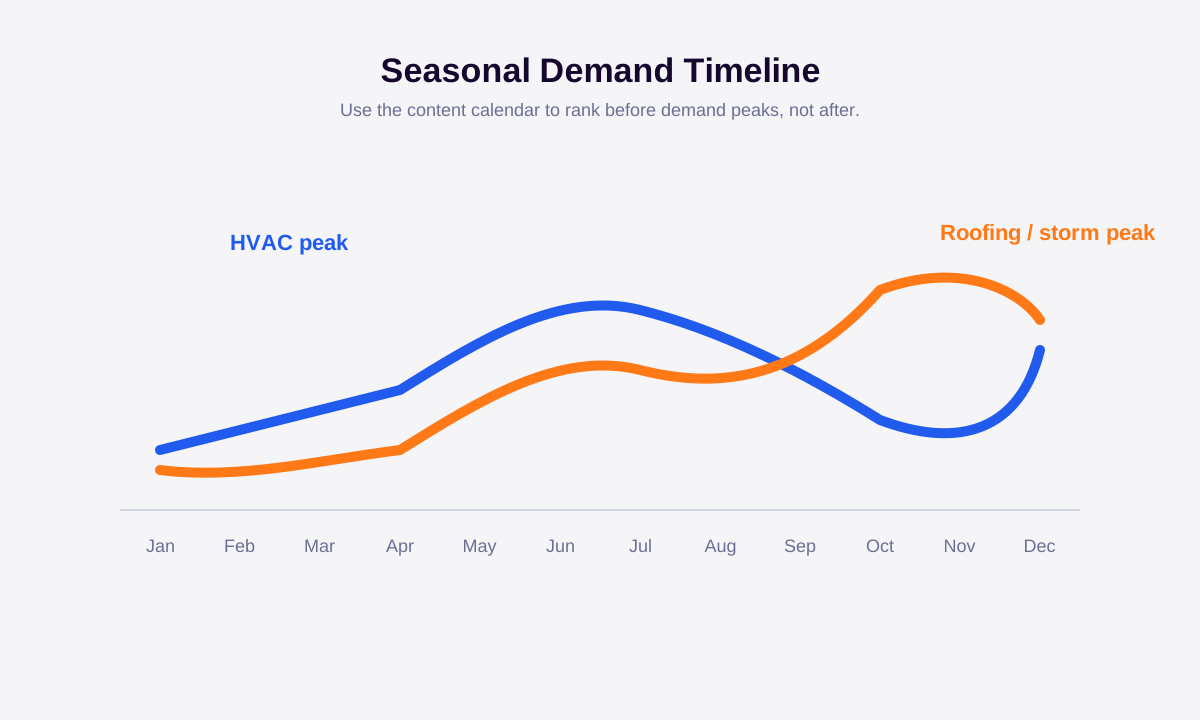
The single highest-ROI HVAC marketing campaign is a spring AC tune-up push. Run it in March–April before competitors start advertising, offer a compelling price ($59–$79 tune-up), and watch your schedule fill up for the next 6 weeks.
Channels That Work for Seasonal Campaigns
- Email to existing customers: Your past customers are already warm. A simple email offering a spring tune-up discount to previous customers converts at 8–15%.
- Direct mail in target neighborhoods: Targeted mailers in neighborhoods with older homes (15+ year HVAC systems) have high conversion for tune-ups that often discover equipment that needs replacing.
- Google Ads seasonal bidding: Increase bids on maintenance keywords 4–6 weeks before peak season. Competition is lower before other contractors start their push.
- Nextdoor sponsored posts: See Strategy 5. Spring tune-up promotions work exceptionally well on neighborhood-based platforms.
Seasonal campaigns generate 3× normal appointment volume when executed 6–8 weeks before peak season. The key is starting early — by June, everyone wants AC service and your schedule books out. The smart companies are fully booked before it gets hot.
Strategy 5: Nextdoor for Neighborhood Dominance
Nextdoor is chronically underused by HVAC companies despite being one of the highest-trust platforms for local service referrals. When a homeowner asks "anyone know a good HVAC company?" on Nextdoor, the responses carry enormous social proof — these are their actual neighbors.
Two Ways to Win on Nextdoor
Organic mentions: Your best customers are already on Nextdoor. Ask them specifically to recommend you there if a neighbor ever asks about HVAC. A single recommendation thread with 5–10 neighbor confirmations can drive dozens of calls.
Nextdoor Ads: Nextdoor's paid advertising (formerly "Sponsored Neighborhood Posts") targets by zip code or neighborhood. For HVAC, seasonal promotions and emergency availability ads perform well. Cost is typically $1–$3 per click, lower than Google Ads with more hyper-local targeting.
Strategy 6: Structured Referral Program
Word-of-mouth is how most HVAC companies got their first 50 customers. A structured referral program systematizes that process. Most HVAC companies leave referrals to chance — a formal program can triple your referral volume.
Simple Referral Program Structure
- $50 account credit for every customer who refers someone who books a job
- Referral link sent via text after every completed job
- Quarterly reminder email to your service agreement customers
- Magnets or cards left with customers: "Know someone who needs HVAC service? Here's $25 off for them, $50 credit for you."
The key is making it easy and making it memorable. Most customers would happily refer you — they just forget to, or they don't know you want referrals. Put the ask in your post-job process so it happens consistently.
Strategy 7: Follow-Up Automation for Estimates
The average HVAC company closes 30–40% of estimates on the first contact. Companies with automated follow-up sequences close 55–70%. That gap represents real money — if you send 20 estimates/week and close 10 more per month, at $4,000 average, that's $40,000/month in additional revenue.
The 5-Touch Follow-Up Sequence
- Same day: "Hi [Name], here's your estimate for [service]. Let me know if you have questions — I'm available by text or call."
- Day 2: "Just following up on the estimate. Have you had a chance to review it?"
- Day 5: "Wanted to make sure you saw this — we have an opening [date] that I could hold for you."
- Day 10: Value add — "Quick tip: [relevant seasonal advice]. Happy to answer any questions about your estimate."
- Day 21: Final check-in — "Still thinking about the [service]? Our pricing is good through [date]."
Use a CRM with automated SMS and email (ServiceTitan, Housecall Pro, or even a simple tool like GoHighLevel) to run this automatically. Once set up, it runs without any manual effort.
Strategy 8: Build an Unstoppable Review Engine
Reviews are not just a trust signal — they are a ranking factor and a lead generation channel. HVAC companies with 200+ Google reviews and a 4.7+ rating get dramatically more calls than competitors with 30 reviews and a 4.2, even if the lower-reviewed company ranks higher in organic results.
The Post-Job Review System
The highest-converting review request is a personal text from the technician within 30 minutes of completing the job. Not an automated email 3 days later — a human text right after. Train your techs to send: "Hi [Name], glad we could get your [system] fixed today. If you have a moment, a Google review means a lot to our team: [link]"
This approach consistently generates reviews at a 25–35% rate. An HVAC company completing 10 jobs/day can realistically add 2–4 new reviews per day — reaching 200 reviews in 2–3 months.
Strategy 9: Build and Work Your Email List
Email marketing returns $42 for every $1 spent across industries — for HVAC, the ROI is even higher because you're marketing high-ticket services to customers who already trust you. Every customer whose email you have is a future service agreement renewal, tune-up booking, and replacement lead.
What to Send (and When)
- March: Spring AC tune-up offer for existing customers
- May: "Is your AC ready for summer?" checklist + special offer
- September: Fall furnace check-up reminder
- November: "Before the cold hits" furnace tune-up campaign
- January: Service agreement renewal push
- Ongoing: Monthly tips (change your filter, what SEER ratings mean, etc.)
Related HVAC reading
If you are building a steadier lead mix, these guides cover the pages, profile work, and website improvements that usually matter next.
Frequently Asked Questions
What is the best lead source for HVAC companies?
Organic Google search (via SEO and GBP) consistently delivers the best cost-per-lead and highest-quality leads for HVAC companies. Emergency searches convert at near-100% because the homeowner is in immediate need. Google LSA is the best paid channel because you only pay for verified calls, not wasted clicks.
How much does an HVAC lead cost?
Paid HVAC leads from Google Ads average $50–$150 per lead. Google LSA leads run $25–$75. Organic leads (from SEO) average $15–$40 per lead once your rankings are established — about 60% cheaper than paid. Lead aggregators like HomeAdvisor charge $30–$100 but often sell the same lead to 3–5 competitors simultaneously.
How do I get more emergency HVAC calls?
Three things drive emergency HVAC calls: ranking in the Google 3-Pack for emergency keywords, having a fast mobile website with a prominent click-to-call button, and maintaining strong reviews (4.5+ stars with 100+ reviews). 76% of emergency HVAC calls come from mobile search, so mobile speed and UX are critical. Also ensure your GBP shows 24/7 availability if you offer it.
Are service agreements better than chasing one-time jobs?
Service agreements are significantly more valuable long-term. At $180/year per customer, a base of 500 agreement customers generates $90,000/year in recurring revenue before any repair or replacement jobs. Agreement customers are also 3× more likely to choose you for replacements and refer friends and family. Building a service agreement base is the single best thing an HVAC company can do for long-term stability.
How do small HVAC companies compete with big ones for leads?
Small HVAC companies win on hyper-local SEO and speed of response. A large company covering 10 counties can't out-local you in your specific neighborhood. Focus your GBP and service pages on very specific neighborhoods and zip codes. Also, smaller companies typically answer calls faster — a 2-minute response time beats a 2-hour callback every time for emergency leads. Speed and personalization are your unfair advantages.
Want a Done-for-You HVAC Lead System?
If you want help sorting out which channel deserves attention first, book a short audit. We can review your current site, Google profile, lead sources, and follow-up flow with you.
Book Your Free Strategy Call